

A deep dive into Toyota's batteries
Toyota is betting on a specific battery technology for electric vehicles. Will it manage to deliver?
Welcome to Lithium Horizons! This newsletter explores the latest developments, companies, and ideas at the frontiers of energy materials. Subscribe below to get the next article delivered straight to your inbox.
‘‘It is in Toyota's DNA that mistakes made once will not be repeated.’’
― Akio Toyoda, Chairman of Toyota Motor Corporation
Toyota has been sending mixed signals regarding batteries for some time. On one hand, they periodically announce breakthroughs in battery technology, while on the other, they dismiss batteries in favor of hydrogen. This contradiction persists, raising questions on how a company as renowned as Toyota can contradict itself so frequently.
The explanation lies in the significant risk Toyota took with hybrid vehicles in the late 1990s. This gamble paid off handsomely, establishing Toyota as the global leader in hybrid electric vehicles. However, they soon missed out on the trend towards fully battery powered electric vehicles (BEVs) using lithium-ion technology. While competitors were rapidly advancing BEV development, Toyota sought to maintain its edge in hybrid technology, seemingly reluctant to acknowledge that fully electric vehicles might be the superior technology.
Toyota is not contradicting itself; rather, it is engaging in corporate double-speak, leveraging its strengths while simultaneously developing new technologies in hopes of gaining a fresh competitive edge. The question is which one?
What is Toyota currently working on? What do they aim to achieve? What is the future vision for Toyota? These questions inspired this article, where we delve into Toyota's involvement with batteries. We'll start with the history of Toyota's battery engagement, then move on to explore their new technology roadmap, their solid-state battery initiatives, and their patents.
Let's dive in! 🔋
NOTE: if you are reading this in your email client, the text may be clipped due to its length. Click on "View entire message" at the bottom of your email to read the whole article, or open it in your browser or Substack app.
The history of Toyota’s involvement with batteries
Toyota's involvement with batteries didn't start with electric vehicles but with the foundational need for reliable starting batteries in their combustion engine vehicles. Over the years, Toyota has refined its battery technology, ensuring vehicles start reliably in various conditions.
The real turning point came with the introduction of the Prius in 1997, which utilized a nickel-metal hydride (NiMH) battery.1 This was a significant step as it marked Toyota's commitment to hybrid technology. Just a year earlier, in 1996, Toyota established Prime Earth EV Energy as a joint venture with Panasonic to develop these batteries.2 The NiMH battery was chosen for its balance of energy density, longevity, and safety over the then-developing lithium-ion technology, which was less mature and much more expensive.
By the late 2000s, as lithium-ion technology became more reliable and cost-effective, Toyota began exploring the use of lithium-ion batteries. It established the Battery Research Division in 2008 and gradually introduced lithium-ion batteries in various models, including the latest iterations of the Prius and other hybrid models.
Toyota's entry into the fully electric vehicle market came much later. In 2021, it established Prime Planet Energy & Solutions as a new joint venture with Panasonic to accelerate the development of batteries for use in different products. Soon after, in 2022, Toyota introduced the bZ4X battery powered electric vehicle.
Toyota’s new battery technology roadmap
In 2023, Toyota announced its new battery technology roadmap, setting out plans for battery development up to 2030. It promises several new batteries:
Performance battery: Utilizing a liquid electrolyte and lithium-ion chemistry, this battery promises a 20% cost reduction for new electric vehicles compared to the bZ4X model. It aims to charge from 10% to 80% in 20 minutes or less, offering a driving range of 800km.
Popularisation battery: Also using a liquid electrolyte with lithium-ion chemistry, this version incorporates an lithium iron phosphate (LFP) cathode and a bipolar structure. It should reduce costs by 40% compared to the bZ4X, achieve a 10% to 80% charge in 30 minutes, and provide a range exceeding 600km.
High-performance battery: This type features a high nickel NMC cathode and a bipolar structure with liquid electrolyte, aiming for a driving range beyond 1000km. It offers an additional 10% cost reduction over the Performance battery and supports ultra-fast charging in under 20 minutes.
Solid-state batteries: Scheduled for mass production post-2027, these batteries are designed to offer over 1000km of range with a fast charging capability of just 10 minutes.
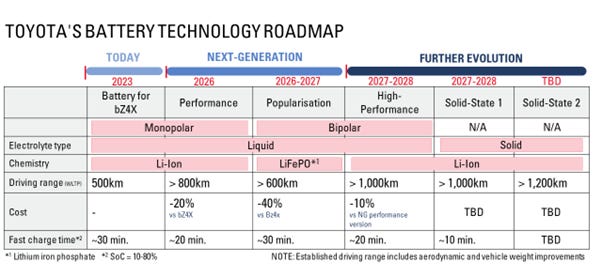
This roadmap essentially outlines a new platform for BEVs, akin to what Ford is developing. The focus here isn't solely on the battery itself but also on how the battery integrates into the vehicle's design. For instance, you may have observed that electric vehicles often have a higher base due to the battery pack running underneath them. Toyota is making efforts to decrease the height of these batteries to lower the vehicle's frontal area, which in turn reduces the drag coefficient. Aerodynamics are crucial in defining the driving range of vehicles, so in the pursuit of maximizing BEV range, optimizing the drag coefficient is key. Toyota's target is to slim down the battery pack's height from 15 cm to 10-12 cm.
Therefore, Toyota is pursuing a holistic approach, a complete vertical integration. They are considering everything from the materials used in the batteries, to their manufacturing processes, and their integration into vehicles. Toyota aims for a complete solution: to redefine what an electric vehicle company is… starting from 2026!
Solid-state batteries
There are many companies that have claimed to have brought solid-state batteries to the market. None of these were really solid-state; there was always some amount of liquid electrolyte being added, making them semi-solid at best. So, to differentiate the 100% solid-state batteries from the rest, a new term started to be used: all-solid-state batteries.
The majority of all-solid-state battery producers are currently testing their products in pilot environments. Doing so are the major automotive players such as Toyota, Nissan, and Honda, and major battery cell manufacturers, such as BYD, ProLogium, and Solid Power.3
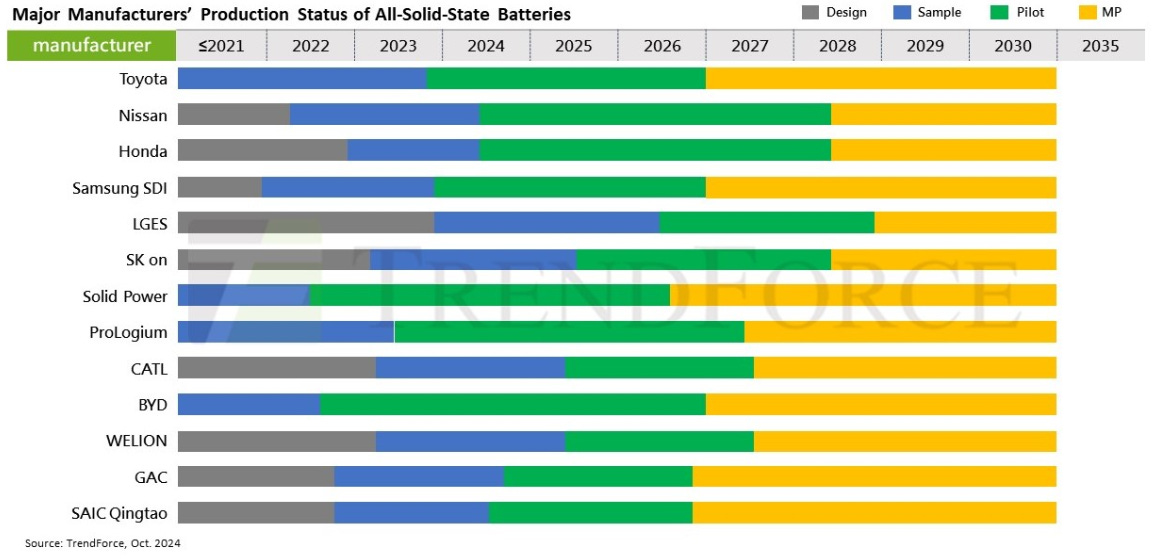
Automotive companies, in particular, are interested in solid-state batteries due to their promise of higher energy densities and improved safety, both of which are crucial for automotive applications. However, these batteries also present several challenges.
One significant issue is cycle life; with each charge and discharge cycle, solid-state batteries tend to store less energy. Toyota claims to have solved this problem and is now focusing on streamlining production. Here, they face another major challenge: achieving high yields and ensuring quality. Mass-producing solid-state batteries at scale is extremely difficult.
Toyota’s patents
To accurately assess Toyota's standing in solid-state battery technology, a review of their patent activity is crucial. Most of Toyota's battery-related patents have been filed after 2018, suggesting a relatively recent but intense focus on this technology.4 Despite a late entry into the battery sector, Toyota has rapidly advanced, now surpassing LG Energy Solutions, Samsung Electronics, and Panasonic combined in the number of solid-state battery patents held.
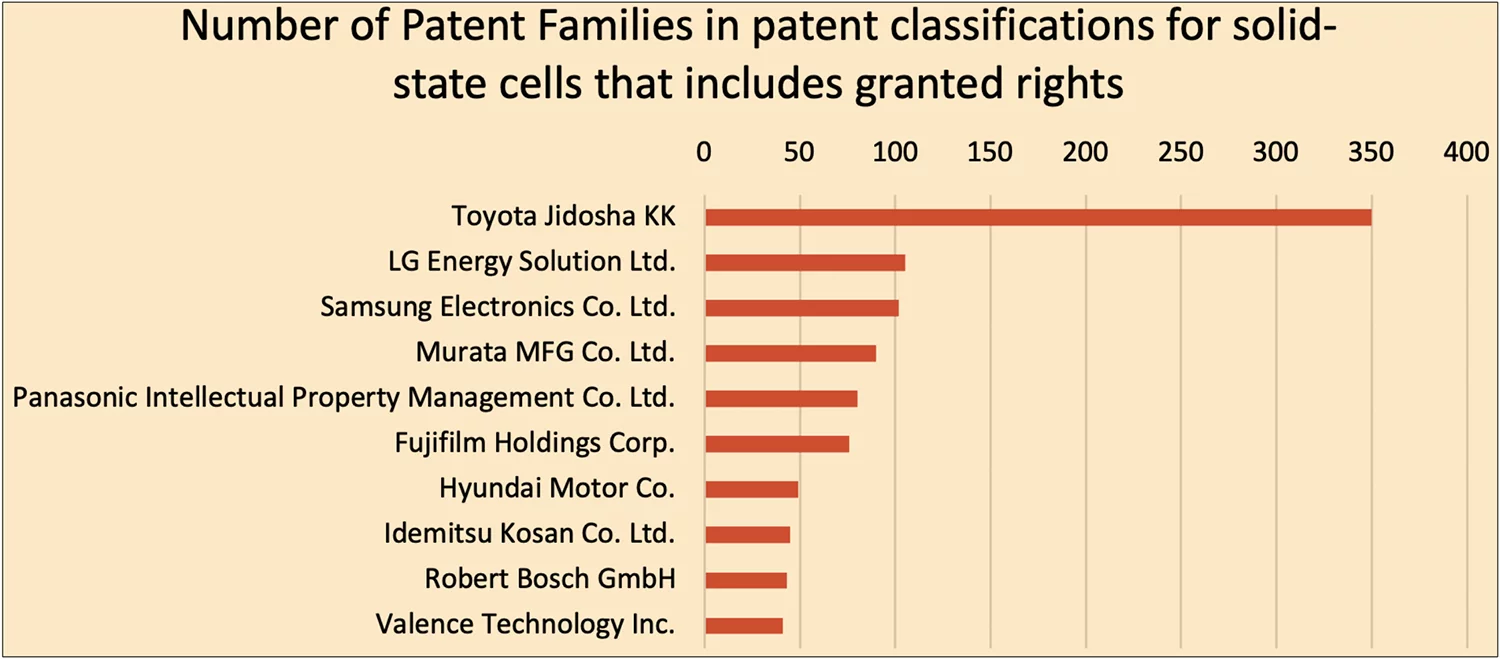
Their patents encompass significant segments of the battery value chain, including, battery materials, battery cell design, battery manufacturing processes, and battery systems. Here are some examples of their patents:
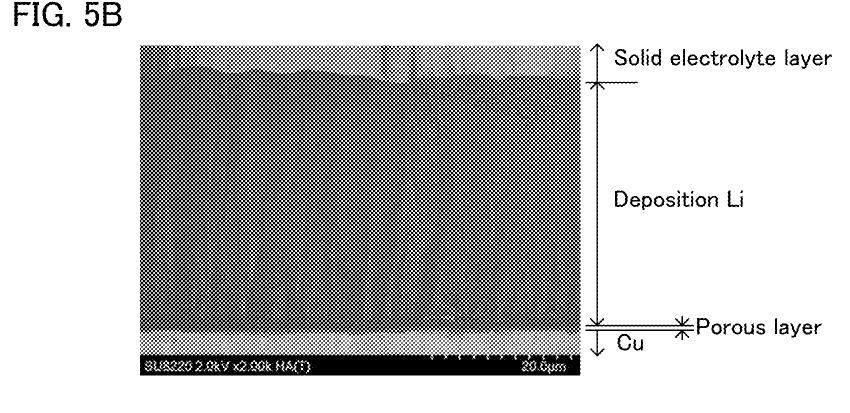
US20240194943A1 (filed February 26, 2024) discloses a solid-state battery featuring enhanced reversibility in lithium deposition and stripping, thus preventing short-circuits. This design incorporates an anode current collector covered with a fluoride-based porous resin layer less than 14 micrometers thick, a solid-state electrolyte, a cathode active material, and a cathode current collector.
The resin layer, with a resistance ranging from 1 to 690 Ohms, serves as a substrate for lithium metal deposition. This setup represents an anode-less battery cell design where the anode is not pre-assembled but forms in situ during the cell's operation, thereby increasing its energy density.
US20240194939A1 (filed January 12, 2024) describes a method for manufacturing a bipolar-type all-solid-state battery where the components—cathode current collector, cathode active material, solid-state electrolyte, anode active material, and anode current collector—are laminated together. This laminated stack is encased in resin along its sides, with extensions from both the cathode and anode current collectors protruding beyond the laminated area. These extensions feature a surface roughness that is 2.5 times greater than that of the current collectors themselves, serving as tabs for welding and assembly into a cell. Bipolar battery designs offer several advantages over the monopolar designs prevalent in current batteries, including lower costs and faster charging capabilities.
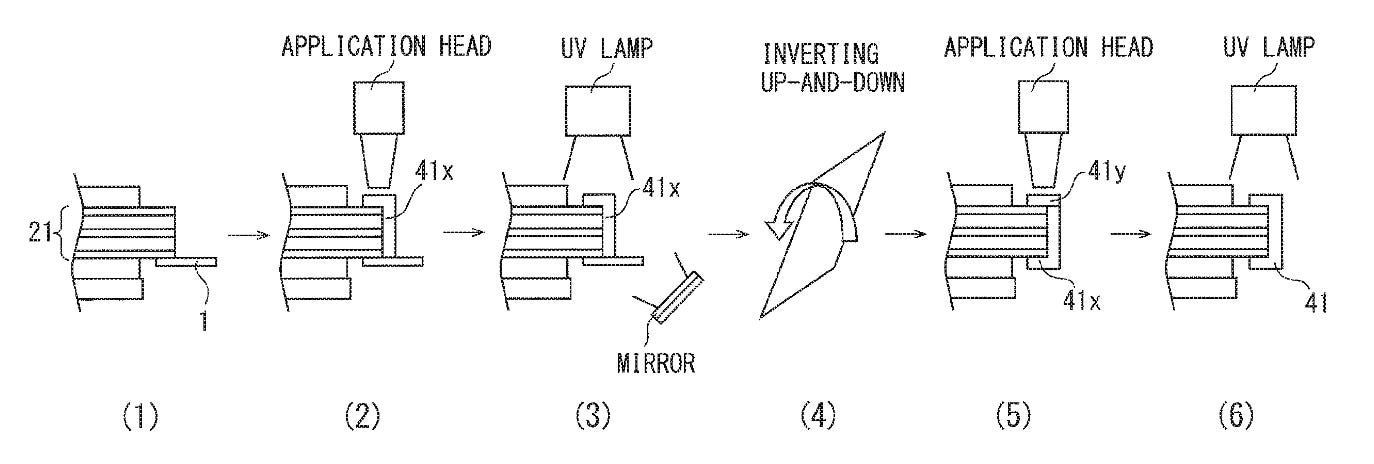
US11088397B2 (filed May 7, 2019) describes a method for producing solid-state batteries that eliminates the risk of short circuits between the anode and cathode by coating the edge of the cell stacks with a curable resin. The patent details how this resin is applied during the manufacturing process on a production line.
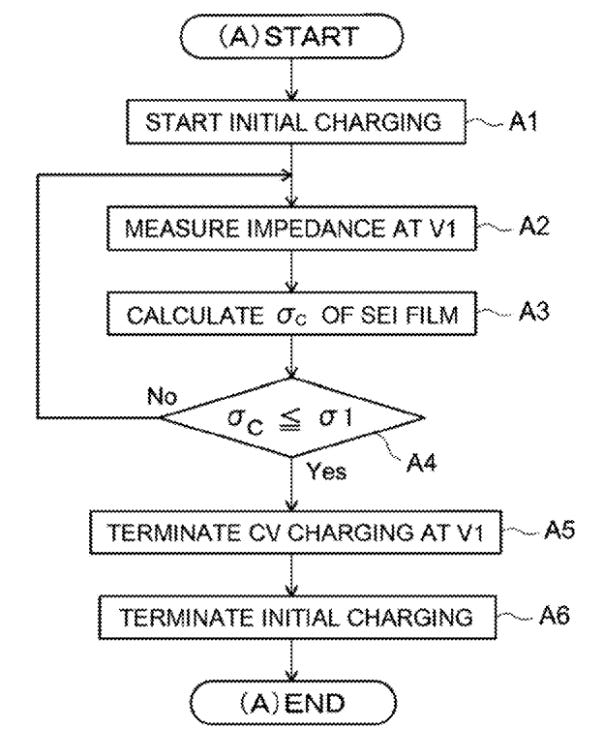
US11824172B2 (filed September 1, 2023) describes a method to expedite the formation of solid electrolyte interface (SEI) using AC impedance measurements to assess when the interface's conductivity reaches an acceptable level. Traditionally, battery cell formation, or priming, involves multiple steps of charging and discharging at varying temperatures and current densities to establish a stable SEI between the electrolyte and electrodes. Toyota's approach introduces an adaptive technique where formation is tailored to each cell individually, incorporating a feedback loop from conductivity measurements to decide when to conclude the formation process. This innovation could accelerate battery production, reduce costs, and result in safer, more efficient batteries.
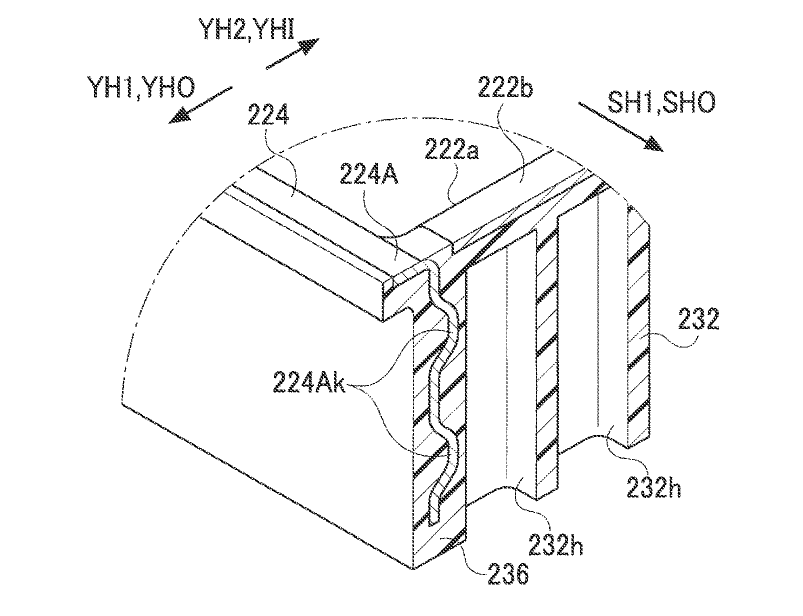
US20240021860A1 (filed August 8, 2023) describes a method for producing a battery pack that is both lightweight and durable, capable of applying the necessary compressive forces on the batteries without the use of bolts and nuts. This is achieved through a sandwich panel design incorporating interposed low-density materials, which provides the requisite strength to exert pressure while remaining light enough for automotive use.
Other patents disclose new sulfide-based solid-state electrolytes with better ionic conductivity (US20230231188A1), sulfide-based solid-state electrolytes that are stable when in contact with humidity (US20240243351A1), coating of cathode particles to stabilize them when in contact with sulfide electrolytes (US20220271296A1), silicon anodes (JP2024144489A), and fluoride-based solid-state electrolytes (US20230136520A1). You can check all of Toyota’s patents here and here.
Toyota’s solid-state battery(ies)
Although Toyota has been exploring batteries pretty widely, dabbling in different chemistries and battery configurations, a picture has started to emerge.
They have made significant strides in addressing the challenges associated with sulfide solid-state electrolytes, covering everything from handling these materials on production lines to managing their reactivity with moisture. Sulfide electrolytes are prized for their performance, yet their sensitivity to moisture, which can result in the release of hydrogen sulfide gas upon contact with water, presents a serious difficulty. If Toyota has successfully mitigated these issues both in production and application, this would represent a major breakthrough. Additionally, Toyota has ventured into the use of lithium metal anodes, exploring both the conventional method where a thin layer of lithium metal serves as the anode, and the innovative anode-less cell design, where the lithium metal anode forms in situ during cell operation. Their research has focused on overcoming challenges such as lithium deposition irregularities and dendrite formation. The irregular deposition of lithium can lead to dendrites, which are like "branches" that grow towards the electrolyte, risking a short circuit. This is a critical issue that all companies developing solid-state batteries with lithium metal anodes must address. Toyota has also tackled issues concerning the volume changes in silicon anodes and the resultant increase in cell resistance.
The centrality of sulfide electrolytes is hard to miss. Toyota seems to be betting on a portfolio of batteries all centred around some type of sulfide electrolyte with different anodes and cathodes, depending on the application. This comes at no surprise and may explain Toyota’s partnership with Idemitsu, a fossil fuel company, since sulfur is a convenient byproduct of petroluem refining. Idemitsu has invested years in developing techniques to mass produce sulfide solid-state electrolytes that would enable high energy density and safety, as well as long life and excellent rapid charging—all attributes Toyota claims its batteries will possess.
Koji Sato, President and CEO, Toyota Motor Corporation, further explains:
‘‘Since 2013, our partner in working together to solve this issue has been Idemitsu, which was one of the first companies to conduct the development of elemental technologies for solid-state batteries. One such elemental technology is a highly flexible, adhesive, and crack-resistant solid electrolyte. Through repeated trial and error and by combining the material technologies of both companies, we have been able to develop a crack-resistant material that demonstrates high performance. By combining this new solid electrolyte with the Toyota Group's cathode and anode materials and battery technologies, we are now on the path toward achieving both performance and durability in solid-state batteries. The key theme for us going forward is mass production.’’
If Sato’s words are to be believed, the prototype cells have already been achieved and tested internally. This is where the 745 mile battery and all the periodic ‘‘battery breathrough from Toyota’’ news may be coming from—prototypes. While prototypes are indeed a breakthrough, between a prototype and market adoption there is a completely different challenge of mass manufacturing at an acceptable cost, something that has become a kryptonite for many battery producers.
Still, Toyota is a manufacturing powerhouse and this would not be their first rodeo in manufacturing complex products. As seen from their partnerships and their patents, they are using a holistic approach, considering both the upstream and the downstream sides of the battery cell. They are innovating not only on the cell chemistry, but also on how that cell is best produced and how it is best integrated into electric vehicles. Toyota is laying down a strong foundation that could catapult it to the forefront of electric vehicle manufacturers.
While there are risks, Toyota is hedging its bets with liquid electrolyte batteries, and even if these sulfide solid-state batteries prove to be impossible to mass produce for the automotive market, they may be suitable for other specialized applications such as satellites and drones. Whatever happens, Toyota has entered the battery market to stay.
That’s all for now — until next time! 🔋
If you enjoyed this piece, consider sharing or subscribing to Lithium Horizons. It helps support future articles on materials powering the energy transition.
Read More


How Toyota came to work on hybrid vehicles is a fascinating story on its own. Here’s a good source to get you started: https://www.roadandtrack.com/car-culture/a44852534/toyota-hybrid-system-how-does-it-work/
Prime Earth EV Energy has recently changed name to Toyota Battery Co. Ltd.
It is curious that CATL seems to be late to the solid-state party. This is in agremeent with their CEO’s words: China’s ‘battery king’ dismisses solid-state EV commercialisation as years away.
Toyota announced their first attempt at solid-state batteries back in 2010. Despite that, the major push came only after 2018.
Fantastically written! Very enlightening.